Why
Nix evaluates nixpkgs with an interpreter, and an interpreter gives you a value. jinx gives you a program, and the tools built for TypeScript work on it.
Profile an evaluation
node --cpu-prof on firefox.drvPath, folded through the source maps
so every frame is a line of nixpkgs:
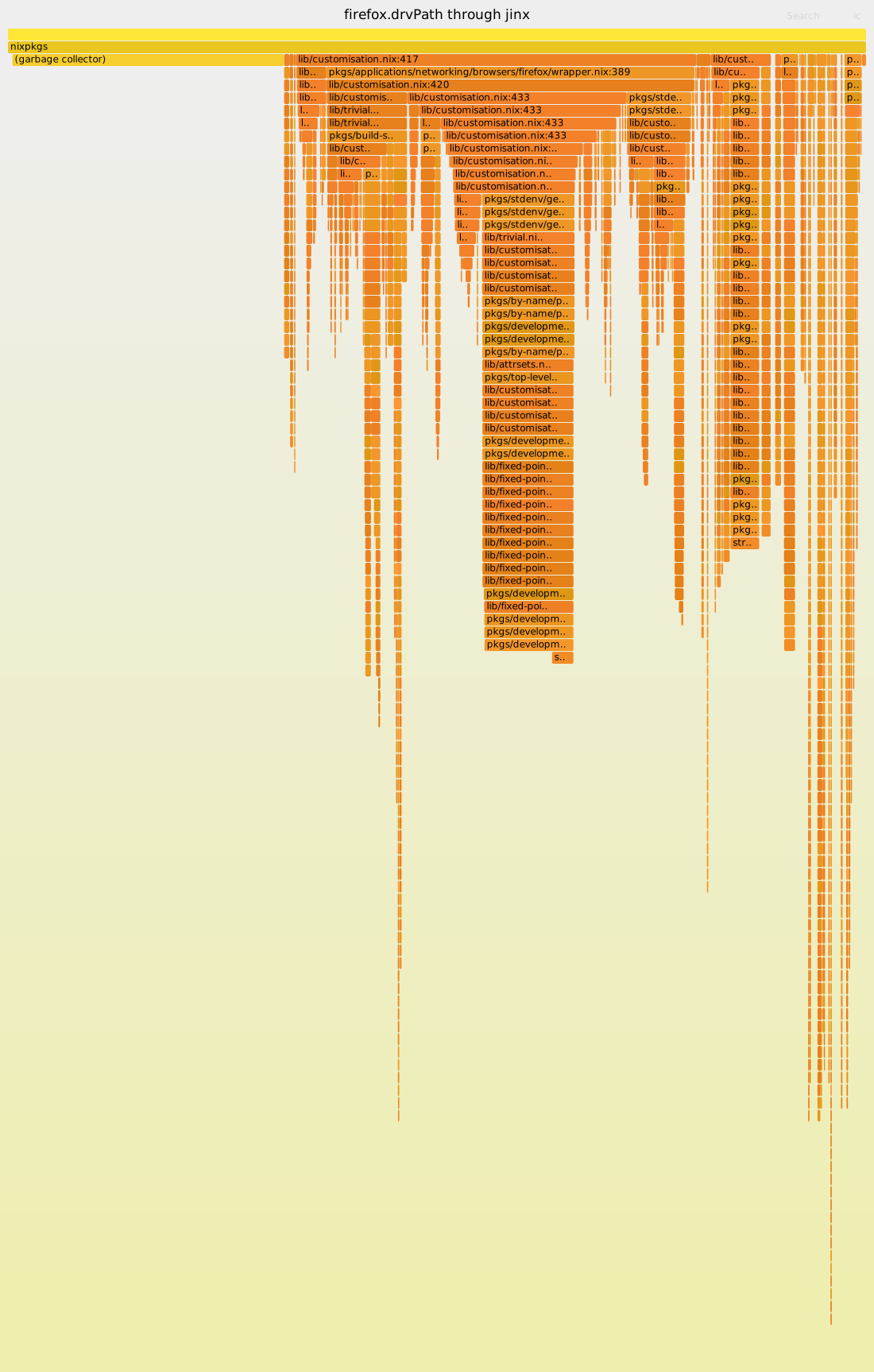
The top of the graph. Click it for the whole SVG, with zoom and a share on hover.
The widest frames are lib.makeOverridable
in lib/customisation.nix and the firefox wrapper, and the module
system's make-derivation.nix. pandoc under the wrapper is a tenth of
the run: that is where hackage-packages.nix gets loaded.
$ node --cpu-prof --cpu-prof-dir=prof src/cli/main.ts eval firefox.nix
$ node tools/flamegraph.ts --nix-only prof/*.cpuprofile > stacks.folded
$ flamegraph.pl stacks.folded > flamegraph.svg
Complete nixpkgs in the editor
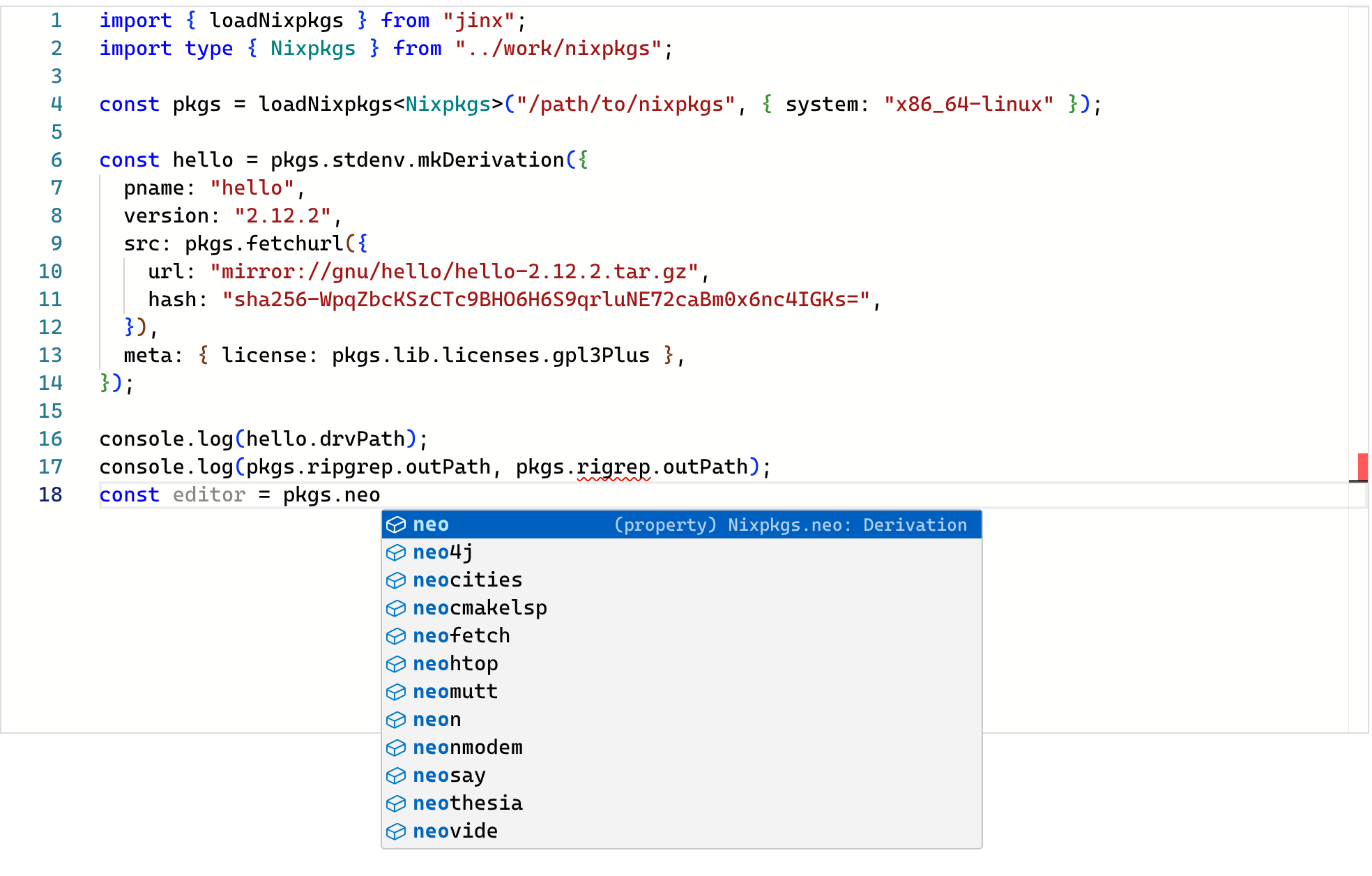
tools/gen-nixpkgs-dts.ts writes a declaration file for a package set:
every attribute, lib's functions with their documented signatures,
and the shape of a derivation. With it, pkgs. completes and a
misspelled attribute is an error before anything runs. With
--positions, hovering an attribute shows the file and line that
defines it, as a link VS Code opens.
Step through a package
Source maps put a breakpoint on a .nix line. Open the compiled tree
in VS Code or Chrome DevTools, break in pkgs/by-name/he/hello/package.nix,
and step into stdenv.mkDerivation as it builds the attribute set.
A direct import ./x.nix names its compiled module in a type, so
go-to-definition follows it across the tree.
$ node --inspect-brk --enable-source-maps src/cli/main.ts eval hello.nix
Query nixpkgs in a loop
A view of nixpkgs is an object, so a question about it is a loop:
import { loadNixpkgs } from "jinx";

const pkgs = loadNixpkgs("/path/to/nixpkgs");
const gpl = [];
for (const name of Object.keys(pkgs.lib.licenses)) {
  if (pkgs.lib.licenses[name].spdxId?.startsWith("GPL")) {
    gpl.push(name);
  }
}
console.log(JSON.stringify(gpl));
Test Nix with node:test
A lib function or a package definition is a function in a module, so
it has a unit test:
import { test } from "node:test";
import assert from "node:assert/strict";
import { loadNixpkgs } from "jinx";

const pkgs = loadNixpkgs("/path/to/nixpkgs");

test("hello builds the derivation Nix would", () => {
  assert.equal(
    pkgs.hello.drvPath,
    "/nix/store/cnraiw0hbdl6jzdhbkn8dah2hqj7xgij-hello-2.12.3.drv",
  );
});
Run it in a browser
The nixpkgs page evaluates attributes of the compiled nixpkgs in the tab, fetching the modules it needs, and the playground compiles and runs a snippet as you type.